Losing a permanent tooth is more than a cosmetic issue. The empty space changes how you chew, how nearby teeth align, and over time, how the bone in your jaw is shaped. Whether the tooth was lost to decay, trauma, or extraction, modern dentistry offers two excellent ways to replace it: dental bridges and dental implants. Both restore function and appearance, but they work in fundamentally different ways. Understanding the differences helps you make a confident choice for your long-term oral health.
What Is a Dental Bridge?
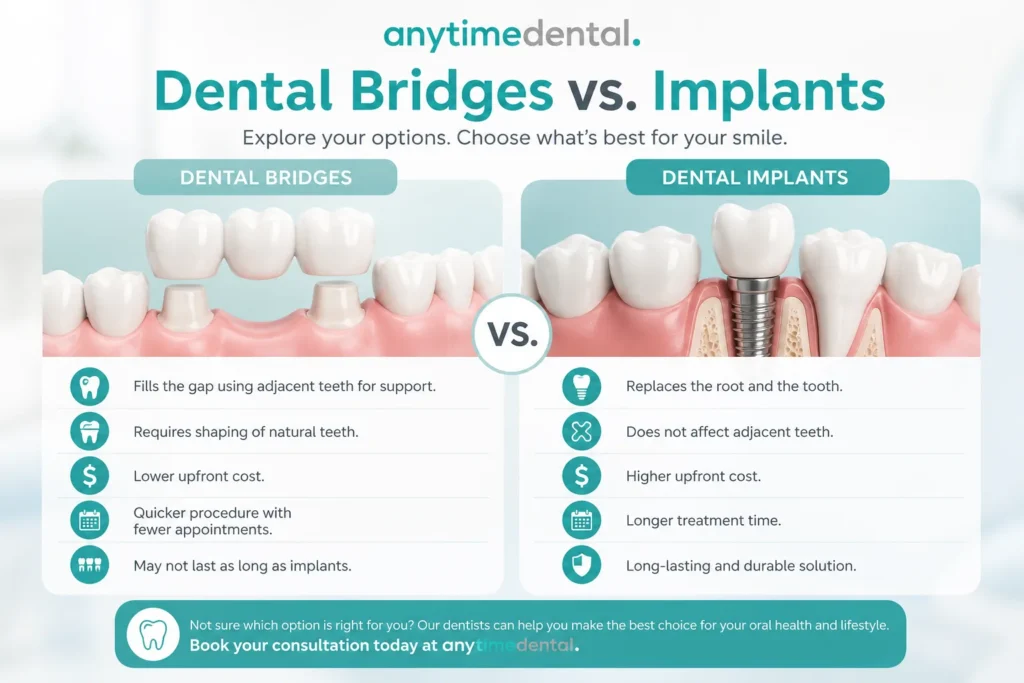
A bridge is a fixed restoration that literally “bridges” the gap left by a missing tooth. The replacement tooth (called a pontic) is held in place by crowns cemented onto the natural teeth on either side of the gap (called abutments). The end result is a connected three-unit structure that looks like three teeth but is one piece.
Bridges have been a reliable option for decades. They are non-surgical, relatively quick to make, and produce a comfortable, natural-looking result. They are usually completed in two to three appointments over a few weeks.
What Is a Dental Implant?
A dental implant is a titanium post surgically placed into the jawbone, where it integrates with the bone over a few months. Once the implant is fully healed, a custom-made crown is attached to the top. The result is a free-standing replacement tooth that does not depend on the teeth around it for support.
Implants have transformed restorative dentistry in the last two decades. They mimic the structure of a natural tooth more closely than any other option and preserve the underlying bone.
Side-by-Side Comparison
Time required: A bridge is typically completed in 2-3 weeks. An implant takes 3-6 months total, because the implant must integrate with bone before the crown is attached.
Surgery involved: A bridge is non-surgical. An implant requires minor oral surgery to place the post, and sometimes additional grafting if there is not enough bone.
Effect on adjacent teeth: A bridge requires preparing (shaping) the teeth on either side of the gap so they can hold crowns. This involves removing some healthy enamel from otherwise intact teeth. An implant does not affect surrounding teeth at all.
Bone preservation: When a tooth is missing, the bone in that area gradually shrinks because it is no longer stimulated by chewing forces. An implant transmits forces into the bone like a natural tooth root and preserves bone volume. A bridge does not — bone loss continues underneath the pontic over the years.
Longevity: A well-cared-for bridge typically lasts 10-15 years before needing replacement. A well-placed implant can last many years, with only the crown needing occasional updates.
Cleaning: A bridge requires special tools (floss threaders, water flossers, or interdental brushes) to clean under the pontic. An implant is cleaned much like a natural tooth, with regular brushing and flossing.
Cost: Bridges are typically less expensive up front. Implants are more expensive initially but often more cost-effective over a lifetime when replacement of bridges is factored in. In Dubai, a single-tooth implant with crown often ranges from AED 6,000-12,000, while a three-unit bridge is usually AED 3,500-7,500 depending on materials.
Success rate: Both have excellent success rates above 95% when done properly in suitable patients. Implants slightly edge out bridges in long-term studies.
When a Bridge Is the Better Choice
A bridge may be the better option when:
The teeth on either side of the gap already need crowns for other reasons (large fillings, cracks). The crowning is happening anyway.
The patient is not a good candidate for surgery — for medical reasons, bone deficiency, or personal preference.
There is not enough bone for an implant and bone grafting is not desired.
The patient needs a quicker restoration and is comfortable with the limitations.
Budget is a major factor in the short term.
When an Implant Is the Better Choice
An implant is usually preferred when:
The adjacent teeth are healthy and untouched. Preserving them is a priority.
Long-term durability and minimal future maintenance matter.
Bone preservation is important — for example, in younger patients who will live with the restoration for many decades.
The patient wants the most “natural” feel and function.
Cleaning ease is a priority. Implants are flossed and brushed like real teeth.
Special Cases
Multiple missing teeth in a row. A bridge can span multiple missing teeth, but the more pontics you have, the more stress is placed on the abutment teeth. For longer gaps, two implants supporting an implant bridge can be a stronger solution.
Front teeth. Both options can deliver beautiful aesthetic results when done by an experienced clinician. Implants often have a slight edge in long-term gum line stability.
Back molars. Implants are excellent for back teeth because they can handle high chewing forces and don’t require sacrificing nearby teeth that may also be vulnerable.
Smokers and diabetics. Both groups have somewhat lower implant success rates. With well-controlled diabetes, implants are usually still a good option. Active smokers are encouraged to quit at least temporarily around implant placement and healing.
The Hidden Cost of Doing Nothing
Whatever you choose, replacing a missing tooth matters. Without replacement, the teeth on either side of the gap drift, the tooth above or below it (in the opposing jaw) over-erupts, your bite changes, and the bone in the area gradually shrinks. Cleaning becomes harder, chewing efficiency drops, and the cost of fixing the resulting problems years later is much higher than the cost of replacing the tooth promptly.
How to Decide
The right choice is rarely about which option is “better” in general — it is about which is better for your specific situation. The conversation with your dentist should cover:
The condition of the teeth around the gap. Your bone volume (assessed by X-ray or CT scan). Your overall health, including any conditions that affect healing. Your budget, both immediate and long-term. Your personal preferences about surgery and timing.
A good dentist will lay out both options fairly and help you decide based on what fits your life — not push you toward whichever is more expensive.
The Bottom Line
Both bridges and implants are excellent ways to restore a missing tooth. Bridges are faster and less involved up front; implants are more durable and gentler on neighboring teeth. For most healthy adults with the time and budget, implants are often a strong long-term option. For others, a well-made bridge is a beautiful, comfortable, and reliable solution.
The single most important thing is to replace the missing tooth before secondary problems develop. Talk to your dentist, get a thorough evaluation, and choose the path that fits your goals. Your smile will thank you.
Related care at Anytime Dental
Related treatments at our clinics: dentures, dental crowns and current offers.
Read more about Dental Bridges and Dental Implants. You can visit our Filipino-speaking dentists at our Deira (Al Rigga) clinic or our Barsha Heights clinic, open daily from 10 AM to 9 PM. Your first consultation is free.