Orthodontic treatment is no longer just for teenagers. Adults are seeking straighter smiles in record numbers — and the good news is that you now have real options. The classic question we get at Anytime Dental in Deira is: Invisalign or traditional braces? Both work. Both produce excellent results. But they are very different experiences. Here is everything you need to make an informed choice.
How traditional braces work
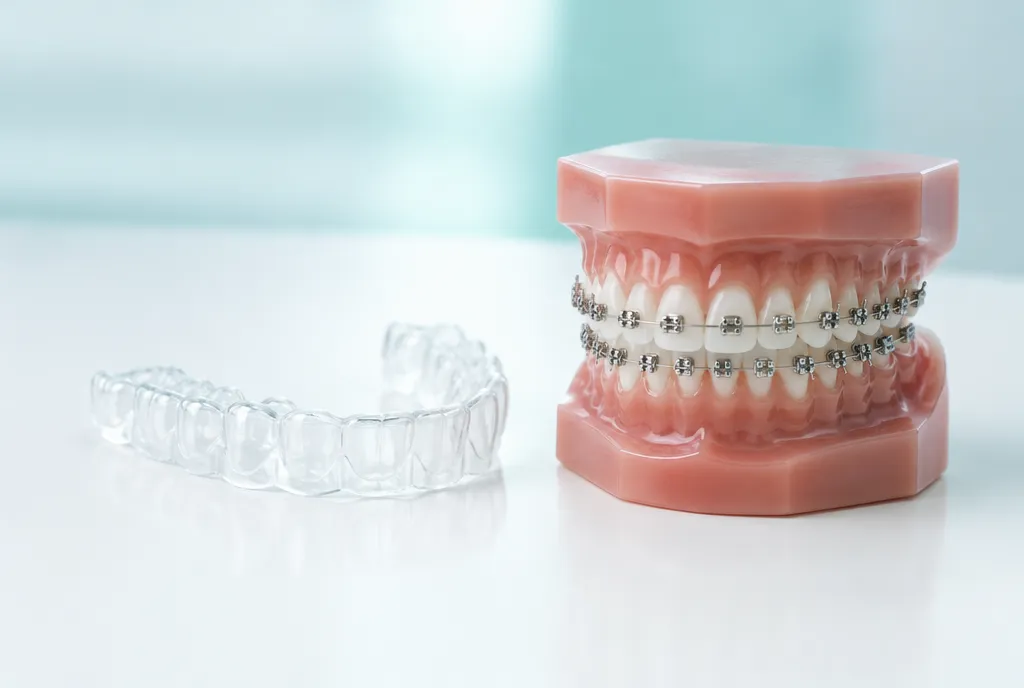
Metal braces have been the workhorse of orthodontics for over a century, and there is a reason they are still recommended for many cases: they are extraordinarily effective. Small metal brackets are bonded to the front of each tooth, and a thin archwire runs through them. The wire is adjusted at each visit (usually every 4 to 6 weeks), gradually moving your teeth into their planned positions.
Modern braces are smaller, lighter, and far less obvious than the bulky versions of twenty years ago. You can also choose ceramic brackets, which blend in with the colour of your teeth and are much less visible.
How Invisalign works
Invisalign uses a series of clear, removable plastic aligners — each one slightly different from the last. You wear each aligner for about one to two weeks before moving to the next. Over the course of treatment (typically 20 to 40 aligners), your teeth are gently shifted into place. The aligners are nearly invisible from a normal speaking distance, and you take them out to eat, brush, and floss.
The honest comparison
Appearance
Invisalign wins for most people. The clear aligners are difficult to notice unless someone is very close to your face. For adults working in client-facing roles — sales, teaching, hospitality, public speaking — this can be a deciding factor.
Comfort
Invisalign generally edges ahead. Braces can irritate the inside of the cheeks and lips, especially in the first few weeks and after wire adjustments. Aligners have smooth plastic edges. Both will cause some pressure and tenderness for the first few days when teeth start moving — that is the treatment working.
Treatment time
Comparable for most cases. Both treatments typically run 12 to 24 months, depending on the complexity of your case. Very complex orthodontic problems may be faster with braces because they can apply more precise force to specific teeth.
Effectiveness
This is where it gets nuanced. Invisalign has come an enormous distance and now successfully treats the majority of cases — including issues that were once considered “braces only”, such as significant rotations and complex bites. However, for very severe malocclusions, traditional braces still have a slight edge. Your orthodontist will tell you honestly whether your case is well suited to aligners.
Eating and lifestyle
Invisalign wins clearly here. You take the aligners out to eat, so there are no food restrictions. With braces you have to avoid sticky, hard, and chewy foods (no caramels, no whole apples, no popcorn kernels) for the entire treatment.
Cleaning your teeth
Invisalign wins again. You brush and floss exactly as normal. With braces, food gets trapped around brackets and wires, and you need special interdental brushes and floss threaders. Patients with braces have to be much more diligent to avoid white-spot lesions and cavities.
Discipline required
Braces win here. Once they are bonded on, they are working 24/7 — there is no compliance issue. Invisalign aligners must be worn at least 22 hours a day to be effective. If you forget to put them back in after meals, or take them out for hours at social events, your treatment will slow down or fail.
Cost
Invisalign and ceramic braces are usually somewhat more expensive than standard metal braces. The price difference reflects the digital scanning, the lab-fabricated aligners, and the technology behind the treatment plan. For most adult patients, the comfort and aesthetic benefits are worth the difference — but we will walk you through all options at your consultation.
Who is Invisalign best for?
- Working professionals who do not want visible brackets
- Adults with mild to moderate crowding, spacing, or bite issues
- People who are disciplined about wearing the aligners as prescribed
- Patients who play wind instruments or contact sports
Who is better suited to traditional braces?
- Patients with severe rotations, deep overbites, or significant skeletal issues
- Children and younger teens whose teeth are still moving rapidly
- Anyone who would struggle with the 22-hour-a-day commitment
- Patients looking for the most affordable orthodontic option
Retention is forever
One thing both treatments share: your teeth want to drift back. After active treatment ends, you will wear a retainer — full-time at first, then nightly indefinitely. This is true whether you chose braces or Invisalign. The cost of a missed retainer is watching your hard-earned smile slowly return to where it started.
How do you decide?
Come in for a consultation. We will take photos, X-rays, and a 3D scan of your teeth, then walk you through both options based on your specific case. Some patients hear “you can do either” and choose based on lifestyle. Others learn that their case is better suited to one or the other and the decision makes itself. There is no wrong choice — only the right choice for you. Book your orthodontic consultation at Anytime Dental and find out which path will get you to the smile you want.
Related care at Anytime Dental
Related treatments at our clinics: current offers.
Read more about Braces and Clear Aligners. You can visit our Filipino-speaking dentists at our Deira (Al Rigga) clinic or our Barsha Heights clinic, open daily from 10 AM to 9 PM. Your first consultation is free.